


IMPROVING PERFORMANCE
BY PRESERVING HEALTH
A team based Performance Therapy approach powered by our Staying in the Green athlete monitoring system.

Performance Therapy
Stay healthier.
Go further.

Return to Play
The art of managing what athletes CAN do today in performance.

Fascial Therapy Techniques
The global network that coordinates athletic movement.

Coach Education
An authentic approach
to career growth.
The Wide Lens, Narrow Focus Approach
Our methodology recognizes that injuries are uniquely complex, but focuses on the factors that matter most: workload management and tissue balance. This is performance therapy, not physical therapy.

Proactive Health
Management
Move beyond reactive injury treatment. Our framework creates a dynamic management process that keeps athletes training and competing.

Balance vs.
Precision
We strategically apply health and precision for performance at the right times, ensuring connective tissues can support what contractile structures produce.

Individual
Archetyping
Through thorough intake processes and emergent understanding, we develop full-scope athlete profiles that drive individualized protocols within team settings.
Preparation vs Restoration: Two Sides of the Same Coin
Performance functions in peaks and valleys. We've expanded beyond just preparation phases to master the entire performance pyramid including restoration, return to play, and performance therapy.

Systems Thinking Over Surface Solutions
Most coaches see problems we see systems. This isn't about adding another technique to your toolkit; it's about fundamentally reshaping how you view injuries, movement patterns, and athlete development.

Performance Therapy Integration
The coaching paradigm is broken when it treats every athlete as a generic case study. Discover how to implement proactive approaches that keep athletes in the green while still driving performance outcomes.

Authentic Movement Analysis
Not every deviation is a dysfunction. Learn to identify true movement archetyping versus normal individual variation, so you stop chasing solutions to problems that don't exist.

Force Plate Analytics Meets Fascial Science
Stop guessing about athlete readiness and start measuring what matters. This groundbreaking approach combines force plate analytics with fascial tissue assessment, giving you unprecedented insight into athlete availability and performance potential.
Authentic Career Growth Beyond Traditional Certifications
A continuing education platform developed by coaches, for coaches featuring real training sessions, actual case studies, and unfiltered truth about what works in elite performance.
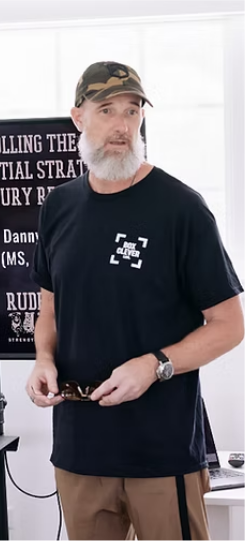
"Danny Foley is a generational talent. Over the past few years, I’ve had the privilege of getting to know Danny well, and what stands out most is his relentless pursuit of understanding and excellence. There isn’t anyone working harder right now to push the boundaries of knowledge in his field.
Danny’s work ethic and ability to connect ideas into actionable results make him not only a standout coach but also an inspiration to everyone in the performance community. Anyone lucky enough to work with Danny will immediately see the depth of his knowledge and the passion he brings to his craft."
-Stu McMillan, Altis CEO
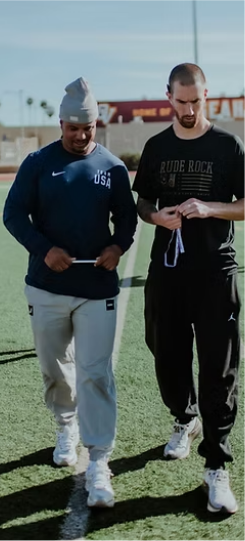
Danny has completely transformed my perspective on pain, injury, rehabilitation, and the integration into performance training. He’s become an essential part of our NFL Combine training process, bringing a unique and highly systematic approach. His passion for learning and constant growth is like a sport of its own—he’s relentless in his pursuit of knowledge to better serve those around him. Danny is a true mastermind in this space, and his impact is unmatched.
-Les Spellman, Founder of Spellman Performance
About Us
The Rude Rock team includes a versatile group of strength and conditioning coaches and practitioners who specialize in athlete return to play and injury restoration.
Rude Rock helps athletes and individuals recovering from injury or embattling pain through a hybrid tandem approach of strength training and restorative applications.
From professional to high school athletes and general population, we help revive athletes and individuals while guiding them back to what they love. Through our fascial driven approach, we are able to addresses the body from a variety of ways, allowing our athletes to return faster and stay longer.
Human First Newsletter
Human First is a weekly note on the parts of high performance that have nothing to do with training leadership, decision-making, self-awareness, and navigating the demands of work and life with more clarity and intent.
Our technical coaching, rehab, and athlete-management content still lives on the website; this is where we think out loud about everything around it.
©2026 Rude Rock Strength and Conditioning, LLC